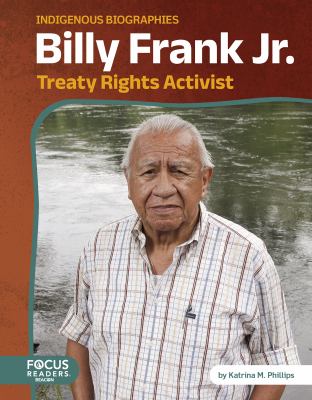
I live in Bellingham, Washington, but I did not grow up here. That means that even though I have walked on Billy Frank Jr. Street, and cross it several times a week when I drive downtown, I did not really know who Billy Frank Jr. was.
Therefore, when I saw Billy Frank Jr.: Treaty Rights Activist in the picture book area of my library, I picked it up. Written by Katrina M. Phillips, who is part of the Red Cliff Band of Lake Superior Ojibwe (and a trained historian), this is a straightforward explanation of this man’s importance. The cover tags it as part of an “indigenous biographies” series, but in truth, it is more half biography, half regional history. For example, the only thing readers get about Frank Jr.’s early life is that he was raised on the Nisqually reservation here in Washington, on family land called Frank’s landing. Except for the fact that he fished with his family, readers get nothing else about that family except that his father Willie was arrested, inappropriately charged with “fishing illegally,” a charge he fought.
That works for Frank Jr.’s role in history, as he was central to the Fish Wars, and in regaining fishing rights for Native people. Younger readers, though, might wonder what his life and family outside of fishing was like.
This is illustrated with pictures–newer color ones, and older black and white, of fishing-related activities–but is otherwise text-heavy–more an early reader/chapter book.
This does a good job of introducing the complexities of regional history, and of linking Native traditions to larger civil rights struggles, and is essential for making history more inclusive and representative. It could, however, be more engaging at times.