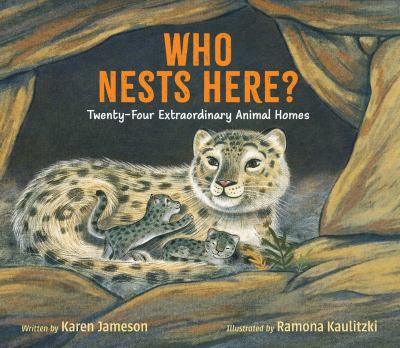
Karen Jameson’s 2026 nonfiction picture book uses the question in the title to guide readers though her book. Who Nests Here? Twenty-four Extraordinary Animal Homes uses short lines and simple rhymes, first to invite readers in generally, then to set the scene in different nesting scenarios. For example, early pages ask who nests in the trees (and branches and with leaves). Jameson then gives several very different answers: gray squirrels, gall wasps, and apes all nest in trees. Jameson then moves on another nesting scenario, in the mud.
Ramona Kaulitzki’s illustrations are arranged regularly: often one larger image filling one page, then two smaller illustrations filling the opposite page. All are useful and gentle. (None really draw attention, but all illustrate the creatures discussed in a slightly softened way, to make young readers at home.)
This sort of organizational structure, where a single idea or principle gets explored in different contexts and/or in different kinds of creatures, can be seen in other science/nature-based picture books, such as Keep On Moving or 13 Ways to Eat a Fly. I have to say, I like it, and appreciate its utility for teaching.
This book concludes with two pages reviewing all the different animals whose nests had been visited in the book, and several reviewing the scenarios (trees, mud, etc.). These blend into just over a page of general principles, like how readers should treat nests and how they can help.
I like and suggest this book, but I see one key area that could be stronger: a clearer discussion of location. The book shows three animals for each nest site, but does not place those sites in the larger world. So, a child seeing images of a mole crab, sea turtles and a scorpion nesting in sand, they might well think all sand houses all of these creatures. Explanations or maps would be useful here.