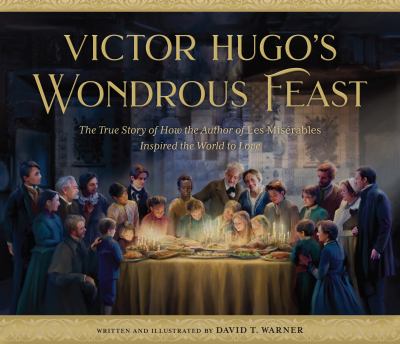
David T. Warner’s 2024 book Victor Hugo’s Wondrous Feast: The True Story of How the Author of Les Misérables Inspired the World to Love is pleasant, but strange.
It tells the story of one aspect of the great author Victor Hugo’s life: his practice of hosting diner des pauvres, or dinners for the poor, where Hugo and his wife hosted and fed a number of poor children for dinner each week. This act, sparked by his wife’s heartache at seeing poor children starving and helpless on the street, became a tradition at the Hugo home. It drew considerable attention, and others imitated it. David Bellos of Princeton credits Hugo’s act with sparking larger social change, eventually the practice of free school lunches. (There’s an NPR story discussing Hugo and this.)
It is easy to see why this would make a children’s book. The images fits: they are idealized and romantic, even gauzy at times. (I first took the cover picture as a variation of the last supper, a connection it is clearly meant to evoke.) The prose too is old-fashioned: clear, but on the wordy and preachy side.
What makes this most old-fashioned, though, is how selective the history presented is. Hugo did do this. He deserves great credit for his art, and his wife deserve tremendous respect for their charity. However, this account of Hugo as a kind of saint leaves out so much that it is essentially hagiography. To speak of Hugo’s actions as showing us how to see “the true light in one another, even the face of God” gets more complicated if you include the whole Hugo. There are accounts of Hugo fighting writer’s block by writing in the nude (so he wouldn’t be tempted to go outside in the cold). And apparently, Hugo did a trick at his dinner parties where he’d jam a whole orange in his mouth, then add sugar cubes and brandy–and then swallow the whole thing.
And there are accounts of Victor Hugo’s sexual appetites. He claimed he made love to his wife nine times on their wedding night. He had many lovers, even into old age, and, after his wife swore off sex, visited brothels so often that when he died, the brothels of Paris had a day of mourning, and many prostitutes visited his funeral. And did business there.
I don’t expect that sort of detail in a children’s book, but to make him all warm and fuzzy really misrepresents Hugo.