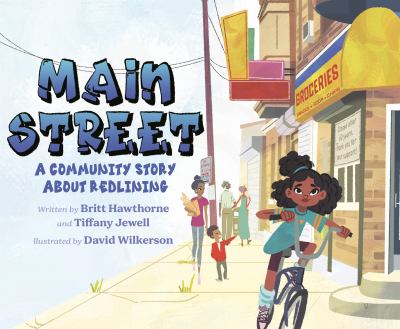
The 2026 picture book Main Street: A Community Story About Redlining, written by Britt Hawthorne and Tiffany Jewell and illustrated by David Wilkerson is an interesting and uneven work.
There’s a long history in children’s books of books about changes in fortune and about changes in living situations, even in the makeup of towns or cities. The kids in The Boxcar Children (1924 and after) live in a boxcar. Virginia Lee Burton’s The Little House, which won the 1943 Caldecott, focuses on a house that gets swallowed up by urban expansion. More recent books like Phoebe Wahl’s The Blue House (2020) focuses on a child’s pain at having to move out of the home they’d been renting.
Main Street is new and needed because it focuses on, as the subtitle indicates, redlining. It finds ways to dramatize the effects of redlining, and gives the pain of redlining a human face. It does so in clear prose, and in bright and appropriately simple images that make pained faces and wincing eyes huge–too large to miss. It evokes the living community that used to be there, and what remains despite the damage of redlining.
The core story, though, is passive and simplified. A story from Ms. Effie is enough to change main character Olivia’s perspective, and the book ends with a block party and a call for everyone to pitch in.
My problem with this is that people have been pitching in on different levels and in different ways for decades, and the forces driving redlining have continued.