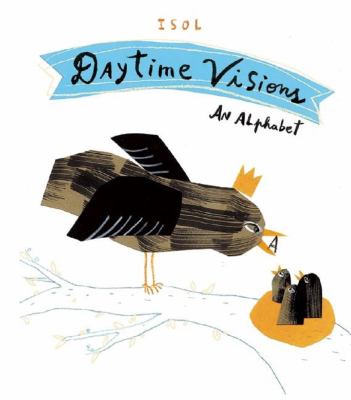
I read my first book by Isol today. It very much won’t be my last.
American readers may not know Isol (she’s from Argentina) but they should. She won the Astrid Lindgren Memorial Award in 2013 for outstanding contributions to children’s literature, and I can see why. Daytime Visions: An Alphabet is, as the subtitle indicates, an alphabet book. Most alphabet books fall into what I call the necessary or functional category. They exist to make learning the alphabet less painful, the spoonful of sugar approach for children’s early education.
Daytime Visions: An Alphabet is that, I suppose, but it is much more. Isol takes the alphabet and treats it as a kind of generally unifying theme for what seems much more like a handheld display that belongs more in an art gallery. The images are simple, but also bold and vivid. They hit like a blend of expressionist art and street political posters.
While the text does go from A-Z, providing illustrations for words that go with each letter, the connections are more stretched and subtle than most alphabet books. Most choose nouns for the words, and often link them thematically. For example, Eric Carle’s ABC gives animals for each letter: an ant for A, a bird for B, and so on. By contrast, Daytime Visions: An Alphabet chooses words that make learners work (and think) more. For A, kids get a creature barking or howling at a bird flying away, and the line “That’s not an answer.” C, though, is illustrated with “Come on!” This verb in the form of a plea or command is spoken t a plant that must not be growing fast enough for the person in the image. For J, Isol gives kids “I was just looking for you,” with a complex/ambiguous picture: a figure (likely a child) looking down at a bird they are holding in a plate or bowl. There are a number of footprints n the ground, and some red feathers from the bird. Are they reunited? Is the bird dead? Questions abound, and are not resolved. Adults who read this with kids should expect lots of discussion. (For X, we get “I’m XX chromosome and I’m expanding.”)
Lovely, complex, and artistic. Not common. The author’s note at the end of the book says, “This whimsical alphabet is like a game,” but if so, it is a mature and philosophical one.