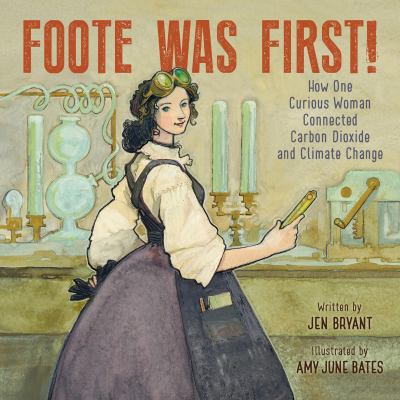
Foote Was First! How One Curious Woman Connected Carbon Dioxide and Climate Change is a recent (2026) nonfiction picture book written by Jen Bryant and illustrated by Amy June Bates. It tells the story of Eunice Foote, an American scientist born in 1819.
This book does several things well. It provides good scientific context and history. It describes Eunice’s questioning mind when she was young, her training, her experiments, and her successes. Later in the book, it spends several pages discussing the broader implications of context change and calls for collective action in response. The book also provides useful historical context, sketching in period beliefs about gender norms and describing Eunice’s involvement in the women’s rights movement (such as her attending the 1848 Seneca Falls Convention). The illustrations tend to be quiet, rather than vivid, but they do a good job of showing period dress, activities, and historical figures like Frederick Douglass (though the hooded coat Eunice wears as a kid when questioning breath and fog looks very modern). Some of them also echo the feel of 19th paintings.
Three elements of this book could be stronger. One of these is central to the story told. A key point about Eunice Foote is that she was the first person to publish a scientific paper on the greenhouse effect, but John Tyndall published on this a few years later and claimed the pioneer spot. The book says “Tyndall ignored her work. Perhaps he never read about her experiment…” Those are quite different! The first is dishonesty and sexism. The second is possible ignorance.
A second point is, sadly, central to reality: because of the nature of Eunice Foote’s life and studies, there’s no real plot or tension here. She grows up, she learns, she makes discoveries, a guy takes credit. Then the explanation of climate change and the need to act.
A third point relates to how the story is told. At times this is a bit wordy, and some of those words would benefit from more explanation (like the relationship between paleontology and geology).
Despite these issues, this is a good and helpful book, doing the essential work of making our history more honest and giving women their due.