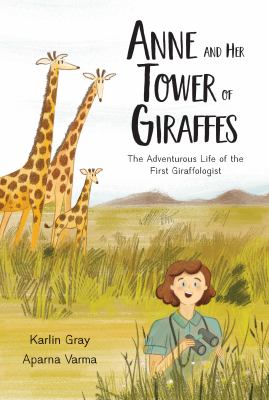
Now that’s a book title!
Okay, let me start again, more formally. Karlin Gray’s 2022 nonfiction picture book Anne and her Tower of Giraffes: The Adventurous Life of the First Giraffologist tells the story of Anne Innis Dagg. Dagg was obsessed with giraffes from an early age, and followed that obsession around the world and into an important career, overcoming obstacles at many steps along the way.
Anne (as the book calls her) fell in love with giraffes at age 4, on a trip to the Brookfield Zoo in Chicago. She carried this strong first impression home with her to Toronto, where she daydreamed about giraffes and tried to read about them. However, she didn’t find any books in the library on giraffes, and while still a kid, vowed to write a book on giraffes someday. Each year in school, she hoped to learn more, but was disappointed.
At age 12, Anne fell ill (scarlet fever), and was hospitalized for a month. She had a birthday while there (#12), and received three stuffed/toy giraffes as gifts. When she was released the hospital planned to destroy them, for fear of spreading germs, but Anne begged them, and they cleaned them instead.
At 17 she visited another zoo, and saw another giraffe. Soon after, she went to a university, where she studied zoology as a way to study giraffes.
One useful thing about Aparna Varma’s illustrations is how they dramatize others’ responses to Anna’s interest in giraffes. The text doesn’t mention other kids laughing at Ann for her desires…but the images show this, both when Anne was a child and when she was at university.
The lack of support in standard venues led Anne to take matters into her own hands: she decided to go to Africa, to study giraffes there, and started approaching people directly . “She wrote letter after letter,” and eventually one ranch invited her.
In 1956, Anne sailed from Canada to England, and then traveled to South Africa. The day after she got to the ranch, she began filming giraffes, observing them, and taking notes on all aspects of them, including at times seeing a group or “tower” of giraffes.
After a year of study, Anne had to go home. She applied for academic positions, but was denied. This led to a career as a writer, which included writing books on giraffes.
(You can find Anne Innis Dagg’s own account of her life here.)
The story ends with Anne on the red carpet for a documentary about her life, and the book follows with two pages of author’s notes, an interview with Dagg, and a page of further resources.
This book is useful for filling in historical gaps, and it does a great job of documenting the idea that kids (or you, or I) can follow our obsessions and make our own paths, and even change the world in the process.
It isn’t perfect–we don’t get a date to anchor the book until Anne sails to England in 1956, and, while the author’s note mentions the political context (specifically apartheid), the book itself essentially ignores politics except for gender–but it is inspiring.