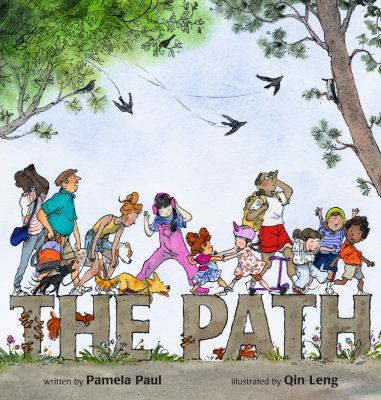
I really like the front cover of The Path. The front of this recent (2026) picture book reads “The Path” in large brown letters along the bottom of the page, and shows a dozen-plus figures who use the path walking across the top of the letters. A nice shorthand of both the book’s images and its content.
This book is about a path that gets shared use: people (and in some cases dogs) walk on the trail, ride bikes on it, skate on it, use it as a place to play (and bark/howl), and pause on it to look at things. With kids, adults, and dogs all using the same path for different purposes, there’s a lot of small conflicts. These conflicts accumulate over several pages, until all trail users are somewhat frustrated.
Then they see something. A huge flock of birds, swarming and swirling together in the sky, They all stop in admiration, and, from that point on, interact in more collaborative and supportive fashions. Rather than complaining about getting in each other’s way, for example, they appreciate one another’s modes of transportation. A little girl pushers herself on her bike to keep up with an older runner, for example, and that runner calls encouragement back to her. Other moments of serendipity follow, like people spotting an owl, then pointing it out to one another.
Pamela Paul’s story of a path works well on a literal level: this describes how people interact (and might interact) on trails. It also works as modest analogy: people can interact this way in all cases of shared resources. Also, it works as metaphor and symbol on a grander scale: we are all on our paths through life.
The moment of wonder is realistic in one sense: such moments happen, and they can shift things. I’ve been on trails or in parks when eagles sweep through, and everyone shifts to appreciation. However, the shift to positive action after was too easy, and is the book’s main weakness. (In life, some people see wonder and get cranky again right away.)
Qin Leng’s illustration is attractive, skillful, and varied. It shifts from efficient symbolism (the cover) to close ups on each individual user and on to larger images showing everyone in relation.