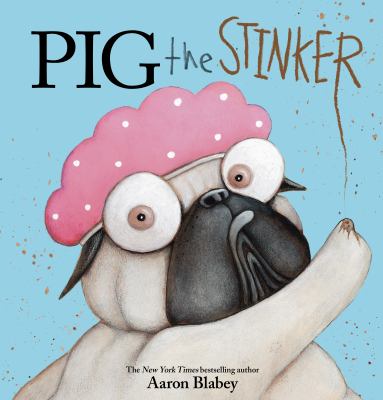
I’m currently working on a picture book about a dirty god–a dog that gets dirty intentionally–and so I’m reading other books about dirty dogs. This led me to pick up Aaron Blabey’s picture book Pig the Stinker.
Pig the Stinker is part of the wildly popular Pig the Pug series, and I have to say, from this book it is clear why so many people–so many millions of people–enjoy the series.
There are several factors that make this series (and this book) so appealing. The first, of course, is the character of Pig. He’s both the essence of a pug and a stand-in for every kid who wanted to be bad, break the rules, and, in this case, get and stay really dirty.
Blabey’s illustrations and design are the second appealing factor. Aaron Blabey’s illustrations are simplified like the best cartoons, but at the same time communicate motion and emotion. Each image is well-placed on the page, sometimes to draw the eye directly, sometimes to make use of page edges and breaks for dramatic impact.
The third factor is the verse. Blabey tells Pig’s story in quatrains that rhyme ABCB. The language is simple and the lines short, but the rhymes work well: “smell” and “well” is common enough, but few poems rhyme “muck” and “yuck.”
Finally, of course, there’s the story itself. Pig is not just dirty, he’s “rancid” and “rotten.” His mess, and his stench, are visible. When his humans decide it is time to bath him, he runs for it, ducking, weaving, and hiding. Along the way he plugs the bathtub faucet, so by the time Pig’s humans do catch him, his plug makes the bathroom explode.
He eventually gets clean, and even accepts baths now without complaint…but for a while, he’s a glorious, filthy, chaos monster.