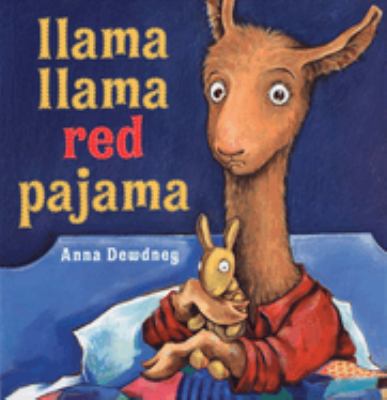
I had mentioned going back to read early/lesser Sendak, and to look at some smaller format books from that period. Today I’m returning to another thread in my ongoing picture book self-education: series built around rhyme. A few weeks ago I reviewed Little Blue Truck (and will be reviewing other books in that series). Today I’m looking at llama llama red pajama, This 2005 picture book (written and illustrated by Anna Dewdney) started a series that has had a wide and varied influence. In addition to the books, the story has been adapted to a musical at Dollywood, made into an animated series, and spawned quite a bit of merchandise. Some of this seems quite logical, like pajamas.
So, what is the original book, and what’s the draw? Well, the appeal starts before the story: the inner and outer cover are full of color, specifically the squares of a quilt, so before a word of the story is uttered, it seems like bedtime: warm and homey. When we get to the title page, we see this quilt on a bed, with a stuffed animal on it.
When the story opens, it does so in short rhyming lines that are fun to read. Page 1, for example, says “Llama llama/red pajama/reads a story/with his mama.” Four syllables per line, and all the words are either very familiar or fun to say (lllllama). Pages 1 and 2 are a unified spread, and all of page 2 is a gentle image of the mother llama reading to the young llama.
The spread on pages 3 and 4 moves to an ABAB rhyme structure, and shows us the mother leaving her cria (young llama) under the quilt we’ve already seen, and heading downstairs.
Dewdney then gives us a story featuring a series of common and realistic incidents: the young llama not going to sleep, wanting a drink of water, calling for his mother, getting impatient, getting upset because his mama isn’t coming fast enough, crying, throwing a fit, getting scared and screaming…which finally brings his mother upstairs. She chides him, reassures him (and delivers a brief lecture), and then lets him know he’s loved and his mother is always here. And he finally goes to a blessed sleep
Several things make this book work so well. First, the llama’s long limbs and long face makes all actions and emotions more active and emotional. Kids can stomp on beds, but the baby llama has hooves.
Second, the illustrations are warm, colorful, and dramatic. Dewdney uses color well. The baby llama in his bed is surrounded by the deep blue of night; Mama Llama, still awake and working, is bathed in white.
Third, throughout the book the rhymes retain their quality: simple, focused, fun. Phrases like “llama drama” make me smile.
Fourth, layout. At key points, words are enlarged or put in color for emphasis.
Combine all of this, and a child who likes this book will be following along by the second go round, and “reading” it alone soon after.
Good stuff.