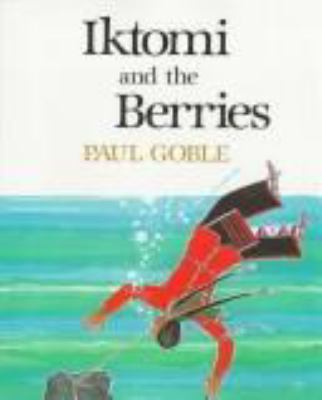
Paul Goble’s 1989 picture book Iktomi and the Berries was an odd read.
I picked it up at my local library because I recently attended the Northwest Raspberry Festival for the first time, and it made me curious about children’s books about berries. The result was, as I said, odd, so odd that I looked Goble up for more background.
That helped but it didn’t really help. It make the mystery larger. Goble was born in England, in 1933, and died in 2017. His family was quite engaged in the arts. His father made harpsichords and his mother was a professional musician. And…according to the art museum at South Dakota State University, he fell in love with Native American traditions at a young age. As child this meant reading everything he could find. As a adult, this meant, after time in the army and studying furniture design at Central School of Arts and Crafts in London, this meant visiting the United States.
He visited many reservations, studied Native American culture throughout his life, moved to South Dakota, and, eventually, was adopted into both the Lakota and Yakima tribes…or said he was. Native American scholar Dr. Debbie Reese of Nambé Pueblo challenges these claims, noting both that the nations Goble claims are quite distinct from one another and that this kind of adoption was not part of their practices.
Taken together, this means Iktomi and the Berries is a book written and told by someone who loves Native American stories, and who immersed himself in those stories, but who is not himself Native. It also means this is a white author telling indigenous stories for his own purposes, so…hmm. Goble is aware of the conflict. The page before the title page includes Iktomi saying “I don’t like it–That white guy, Paul Goble, is telling stories about me again…”
Turning to the book, the images drew my eye first. They are vivid and well-designed, evoking Native designs and color schemes without directly claiming them. Goble repeats some images with minimal variation, pulling attention to details, and changes orientation of images: at times Iktomi is upright, at times sideways, and at times upside down. This fits both the figure, who is a traditional trickster, and the story itself, which involves Iktomi making choices and mistakes, and stumbling through a kind of self-imposed quest.
Goble’s subtitle for the book is “a Plains Indian story,” and rather than claiming authorship completely, he says it is “retold and illustrated by Paul Goble.” After the title page, there’s half a page of references and most of a page about Iktomi and his role in Native stories. There’s also “A Note for the Reader” that explains part of the text’s construction: when the text changes to italics, those lines are meant to represent the kind of side comment common to the oral storytelling tradition–and readers /listeners are invited to join it, making the telling communal.
This sort of back and forth starts with the first lines of the story. The darker text says, “Iktomi was walking along…” The gray italicized text says, “Every story about Iktomi starts the same way.” Immediately, this gives readers a more complex story than is found in many children’s books, a kind of communal metafiction.
The story itself is familiar and pleasant. Iktomi goes hunting, first for prairie dogs, then for ducks. He fails at both, both in the hunting and in noticing what is going on around him. He finally decides to gather the red berries he sees in the water and make “berry soup” from them. He jumps in after them, can’t get them, tries again, can’t find them, and tries again, this time tying a rock around his neck, to make sure he can stay down long enough. As a result, he almost drowns. Only after that, when he is “gasping for air,” does he realize he’d been trying to grab the berries’ reflection in the water.
He’s so mad he beats the berry bushes with his bow, knocking them into the water where the ducks enjoy them.
He gets nothing from all his efforts, and walks on his way, muttering about getting something to eat, maybe “a hamburger.”
The art here is great. The story resonates with traditional storytelling, and I enjoyed this. But I still say “hmm” about Goble’s use of Native American tradition.
Hmm.