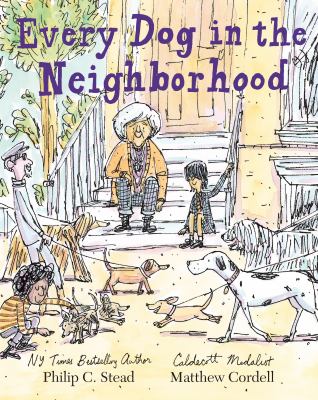
Sometimes you feel like a book was written for you. That was the case for me with the 2022 picture book Every Dog in the Neighborhood, written by Philip C. Stead and illustrated by Matthew Cordell. For 15 years I walked a dog who was so friendly that a dog expert tagged him as “hypersocial.” In the process, I got to know every dog in my neighborhood, and make friends with most of them.
In the case of this book, Louis, the kid who is the first person narrator of the story, things are a bit more complicated. He’s talking with his grandmother (who he spends extensive time with, and perhaps lives/stays with). She is a classic crotchety older woman: she feels the weather in her bones and speaks up when she thinks something is wrong. She takes action, and encourages her grandson to do the same. When he says he wants a dog, she says there are already enough dogs in the neighborhood. He asks how many, and she sets him the task of doing a neighborhood dog census (after the city admits they don’t really keep track).
This gives an easy flow of continuity and change in the book: Louis goes from house to house, knocking on doors and asking if the people who live there have dogs. This means he’s always asking about dogs–but that every home, every family, every dog, and every human-dog relationship is different. Author Philip Stead plays little jokes with some of the dog names, like the three-dog house who own Moose, Goose, and Caboose (and Caboose always leads the way). Some of the jokes are aimed at parents, either to enjoy on their own or to explain to kids (or both), like the dog named E.B., who dreams of writing animal stories. (E. B. White, author of Charlotte’s Web, was a renowned dog lover, so this is a multi-faceted reference.)
Some of the information gathered is more serious, even sad. The best example of this is the first house Louis visits. He asks Mr. Pierce if he has a dog, even though he knows he doesn’t. He learns that he had a dog named Harvey, and “he will always live in my heart.” Louis listed him in his dog census, and I got a little weepy.
While Louis does his dog census, his grandmother is busy with another project: the local dog park was closed, so she renovates it herself. She doesn’t explain what she’s doing, and there’s no discussion of it: there are just some wordless pictures of her mowing, painting, planting, and fixing.
By the end of the book, Louis has his own dog (in a bittersweet moment I won’t spoil for you)…and the neighborhood dogs are enjoying Grandma’s Dog Park.
And you should too.