I met Natasha Tripplett at the 2026 Children’s Literature Conference here in Bellingham, Washington. She was friendly, with a gentle, gracious spirit, and I was intrigued to see what her written work is like.
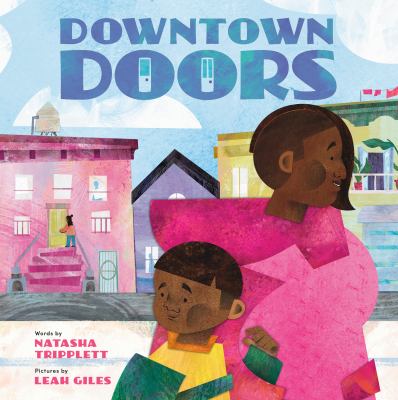
This led me to pick up her 2025 picture book Downtown Doors (illustrated by Leah Giles).
The most immediately appealing aspect of the book is those illustrations. They are colorful and not fully realistic, and really give a sense of shape and continuity throughout the story. That story is important, even necessary, but not fully engaging.
Wendell and his mother go on their “weekly downtown walks.” Readers know this isn’t just a casual walk, taken for pleasure, because before they leave, they each ask the other if they have their cards (unspecified). Their walk takes them past many people, and many buildings with the downtown doors that give the book its title. They pass most doors, and stop to look into or enter a few (the barber shop, the church, etc.). A number of the doors have signs on them, some welcoming, some less so. Some are boarded up, marking businesses that used to be there and now exist only in family memory.
They end up at a community food center, where they show their cards and get groceries for the week. On the way home, Wendell thinks about the doors they’ve seen, and the people, feels loved, and shares some of their food with Mr. David, another member of their community.
Once home, they put the food away, and talk about what Wendell prayed for.
I call this a necessary story because it is one that’s rarely told: a picture book focusing on a community (of color) that is facing economic challenges, but is still engaged, supportive, and loving.
I call this not fully engaging because there’s no tension here. No one struggles with what to do, not even Wendell, who would be the viewpoint character. He just does the right thing, easily.