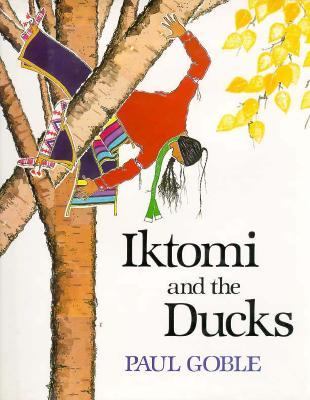
A few weeks ago I read my first Paul Goble book, Iktomi and the Berries. I stumbled across Goble when looking for other things, but have since sought out more books by him due to their complex nature.
As I noted in my review of that first book, Goble’s art and design are both striking. The pictures are vivid and unlike anything found in children’s literature, and he does complex things with design, like including comments in gray from a hypothetical crowd listening to a fictional storyteller, so his work includes snarky asides and models traditional storytelling.
All of that appears in Iktomi and the Ducks. This is another story about a Native American trickster figure, a story told with affection and respect, but told by a white Englishman. Goble is aware of the complexity of this situation, and includes lines on a page before the title page reading as follows:
There goes that white guy,
Pale Goble, telling another
story about me…
My attorney will Sioux.
This story, like Iktomi and the Berries, focuses on Iktomi’s greed and egotism, but this one has a stranger structure. Iktomi gets hungry when he’s walking looking for his horse. He sees ducks, trick them, and kills and roasts some of them. However, the sound of two trees rubbing together bothers him. He tries to separate them, and gets stuck, while he’s up one tree. While he’s stuck, Coyote, another trickster, comes and steals most of the cooked ducks. He leaves just one, and booby traps that one by replacing the meat with hot coals. When Iktomi finally gets down and tries to eat the duck, he burns his mouth.
After jumping in the pond to cool off, Iktomi goes on his way, once again looking for his horse.
That summary doesn’t do the book justice. This has a great rhythm, and there is tremendous energy to the images. And…as I noted before, I now feel uneasy reading this because of Native voices objecting to Goble’s use of Native stories. Add to that the book’s subtitle, “A Plains Indian Story,” and the complexity of the preface, which says that 90% of all Iktomi stories today are new. So…is he saying it is a traditional story? That he made it up, but it is okay because everyone’s doing it? A tangled situation.