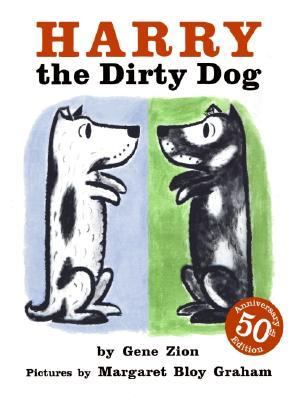
As I mentioned yesterday, I’m currently writing a picture book about a dog who gets dirty intentionally, and so I’m reading picture books about dirty dogs. Yesterday it was Pig the Stinker. Today it’s Harry the Dirty Dog.
Published in 1956, Gene Zion’s picture book is often tagged as a classic. And, while it lacks the power or artistic ambition of something like, say Where the Wild Things Are, it is easy to see why this has lasted for 70 years. The story is simple and relatable. Harry, a “white dog with black spots,” likes everything about his life except baths, so when he hears the bathtub filling, he buries the scrub brush in the yard and runs away from home. He wanders through the city, playing in a variety of work sites and getting so dirty that he changes into “a black dog with white spots.” By this point, he’s hungry and tired (like Max, come to think of it), and goes home.
However, because he’s changed, his family doesn’t recognize him. He tries to prove his identity by doing his familiar tricks, but they don’t recognize him. Finally, he digs up the hidden brush and runs into the house and up into the tub, something he’s never done voluntarily before. The kids wash him, and reveal Harry’s real identity.
The running away both illustrates kid emotions and gives illustrator Margaret Bloy Graham to show us many different city scenes. These illustrations are, like the story itself, quite simple, but they are always easy to decipher, bright, and friendly: even when Harry’s out in the world, the whole thing seems like a playground.