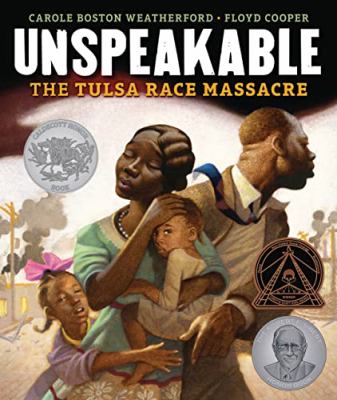
Many picture books are light. They strike a happy tone, and only dip into darkness occasionally. That’s not the case here. The subtitle of Unspeakable (2021) is “The Tulsa Race Massacre.” I put this book in my personal category of children’s books that try to address difficult subjects directly.
Floyd Cooper’s illustrations are strong. They portray people from this long ago time (the massacre was in 1921) in still and striking tableaux, often with a touch of sepia tone like older photographs. There are some photos inside the covers and included with the author’s note and illustrator’s note, but the book (rightly) doesn’t force readers to literally see these horrors–only to confront their reality. Some of these still images carry a lot of implied action and emotion, like the elevator scene that sparked the massacre.
Carole Boston Weatherford’s writing is informative, intelligent, and dignified. It uses the “Once upon a time” structure repeatedly, converting horrific history into story. At the same time, names of specific people, places, and businesses are raised, to help bring this community into focus. The core massacre is described in direct statements, but also with some emotional distance, closer to summary than immersion in the event.
Telling the story of how this community was destroyed is important, in itself, for the African American community, and for larger American history and culture. This book is important for these reasons, and carries the weight of dignity.
There are, however, some elements that could be stronger. Though the cadences of the writing are strong, and would work well if read aloud, some of text blocks are on the longer side for a picture book. Others are oddly spaced, with lines separated like stanzas in a poem, but not always with clear reason. And finally, a judgment call: the very distance that will let adults read this to kids means that some of the brutality is not fully engaged, but only summarized. This is true for the illustrations as well; guns are shown raised for use, but neither the dead bodies nor the ash of the burned neighborhood are shown. I hate to call for this to be shown to kids, but others have shown stylized/distant images of death, and showing the burned cityscape could work.
That being said, this is important. It is easy to see why it was a Caldecott Honor Book, a Sibert Honor Book, and a Coretta Scott King Award winner.