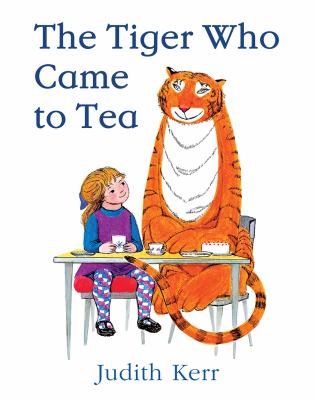
I recently read Why You Should Read Children’s Books Even Though You Are So Old and Wise by Katherine Rundell. In this lovely little book Rundell talks about children’s books, what they are, and why they matter. Necessarily, she mentions a number of examples along the way to illustrate her points. Some writers, like Ursula Le Guin, I have loved for years. Others I was less familiar with. For example, I had heard of Judith Kerr, but I had never read her 1968 picture book The Tiger Who Came to Tea.
I’m sorry about that, because I have read it now, and it is lovely. In many ways, it is what a picture book should be.
One reason for this is the open line, which starts with “Once there was a little girl called Sophie…” Even though the accompanying image is modern, the language links this to fairy tales, and establishes expectations. By the end of that first page, there’s an inciting incident: “Suddenly there was a ring at the door.”
After a couple of pages of reasonable, child-like speculation about who it might be, Sophie opens the door. There’s a tiger at the door, who says he’s hungry and asks if he can join them for tea. Sophie’s mother answers, “Of course, come in.”
That’s the second and third reason: the absolutely arbitrariness that marks children’s books, and children’s experiences, and the matter of fact manner in which the mother responds. Things just happen. Parents just deal with them.
Page after page then discusses and portrays the tiger eating and drinking, first everything at the table for tea, then everything on the stove, in the fridge, and in cupboard, and, finally, all the water in the tap!
All the while he smiles in a confident, knowing fashion that had me wondering if he would end by eating Sophie and her mother.
But he doesn’t. He thanks them for “a nice tea,” takes his good-byes, and leaves, leaving them in a dry and messy house that’s completely empty of food and liquid–so much so that they can’t even give Sophie a bath. That’s such a wonderful touch. Eating everything in a house is gluttony, but possible for a large enough animal. Drinking all the water from the tap is impossible madness, and so a nice touch of magic. I smiled and stroked the page at that point, as I had when the tiger said his good-bye.
Sophie’s father comes home from work to a food-less house, and they deal with the situation by going out to dinner and buying more groceries, including some tiger food, in case the tiger comes back–another nice touch, suggesting the family’s daily world has a touch of magic to it.
The final page shows the tiger playing a flute, and reassuring everyone that he never comes back. That’s the final fine element: the confidence of the narrative voice, able to make absolute statements.
A gem. Read it.