Recently I read Doris Burn’s picture book Andrew Henry’s Meadow, and my response boiled down to “This is one of the greatest picture books ever” and “How did I not know about this earlier?”
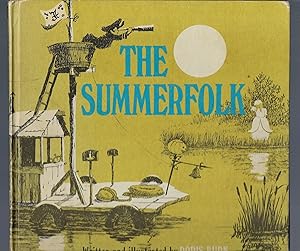
My response to Burn’s 1968 picture book The Summerfolk is much the same. I wasn’t quite as personally captivated, but I liked it very much, and the illustrations–once again black and white–are truly wonderful. There’s an awareness of space and line that is rare in all images, let alone picture book illustrations.
This book starts with a near-cliche: local folks who live near the water and live a rustic life–the father is a fisherman, and the first image is of the boy and his father mending nets–have to put up with “summerfolk” who come to the area for vacation. They are fast and loud and messy, and the locals complain about them and how they disturb their lives. So far, so good. Realistic enough: anyone who lives near a coast, or near a season-specific tourist attraction, has experienced something similar.
Then one day Willy (the boy) is out having a quiet day finding pollywogs and dragonflies in the swamp when he feels someone watching him. It turns out to be Fedderly, another kid, and one of the summerfolk, who is, judging by the amazing illustration when he appears, a cross between Oliver Twist and Peter Pan. His clothes, stance, and expression scream magical disruption.
Fedderly has a boat, and coaxes Willy to add his boat, so they have a flotilla. Fedderly leads them to Rosebud’s, who feeds them brunch and then joins their flotilla. They go on to visit other marvelous summerfolk, each of whom is different, each of whom is new to Willy, and each of whom has a (different) boat that joins the flotilla.
There’s an entire magical day of experimentation and accumulation, and Willy feels “a little empty” and “a little sad” when everyone has to say good-bye at the end of the day.
When he returns home, his father is still grumbling the same complaints about summerfolk, but Willy speaks up, suggesting “there’s summerfolk and summerfolk.”
Rarely have I read a picture book that worked so much through image and implication, and that was at once so original and so true to life. As I write this, this book is out of print, which seems a genuine crime. But your library might have it, or interlibrary loan. But my gosh, read this.