Since this my third post on the Iktomi books written by Paul Goble (see this earlier review), you can correctly assume I find these books interesting. I like them, but don’t love them, and I’m intrigued to see what Goble does with his subject matter. So, I checked out three more Iktomi books from my library: Iktomi Loses His Eyes, Iktomi and the Buzzard, and Iktomi and the Buffalo Skull. Each of them has the same subtitle: “a Plains Indian story.”
Each is both told and illustrated by Paul Goble, who is not a Plains Indian, or descended from any other Native American nation. Goble was born in England, but was drawn to Native American culture and stories from a young age. Trained in the arts, he traveled to the United States in his twenties, and began an extended exploration of Native American culture. The result is complex. On the one hand, Goble dedicated years to learning about Native American culture. On the other hand, he’s retelling Native American stories but is not a Native American, and some have objected to this. On a third hand–something possible for a trickster figure like Iktomi, Goble is aware of these tensions, and they are, in some ways, appropriate to trickster stories. For example, before the story proper starts in Iktomi Loses His Eyes, Goble has a preface from Iktomi’s point of view that says “This is more likes about me by that white guy, Paul Goble,” complains about not getting royalties, and urges kids to call for the book to be banned.
Obviously, it wasn’t, but this is a tangled knot of culture.
Goble’s Iktomi books fit together through sharing a character, a voice, a striking, lovely visual style, and a method of presentation. (Goble uses black text for the main story, and gray to model the sort of comments listeners might make while listening.) They do not, however, need to be read in any particular order. They are episodic, like stories about mythic or legendary figures (Hercules, King Arthur), where people can sit down and hear another story without worrying where they fall in a sequence.
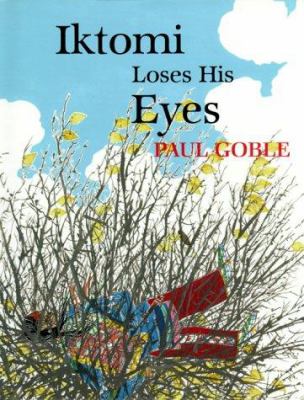
Some elements of these three books, as the titles suggest, are darker than then ones I read earlier. Iktomi Loses His Eyes is wordier than some of the other books, and the trickster literally loses his eyes due to trying to cheat a magic trick he’d recently learned. He then stumbles through the world–and this really cries out to be acted out by the storyteller–until he is eventually helped by animals: first a mouse, then a buffalo, donate their eyes. These kind actions aren’t enough, and he is so lost in his world that he mistakenly swings a tomahawk at his own feet!
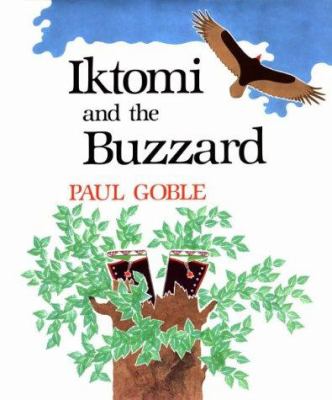
ktomi and the Buzzard, has a similar preface before the story, in which Iktomi says “This book is ethnically insensitive” and “its racial epithets just bring me into contempt, ridicule, and disrepute.” The ongoing issue here, though, is that some of those qualities belong with tricksters: they carry ridicule.
In this book, Iktomi is walking to a powwow, dressed for the event and proud of himself. He tries some dance steps as he walks, but then his path is blocked by a river. He cajoles a buzzard to carry him across the river, and both enjoys and appreciates the ride. However, Iktomi stays Iktomi, and begins to mock the buzzard’s bald head and make rude gestures. The buzzard drops Iktomi from his back, and he falls into a hollow tree. Some woodpeckers try to free him, but he stays stuck, head down in a tree, until he tricks two passing girls into thinking he’s a raccoon they could catch. They chop into the tree, and he’s once again free and on his way.
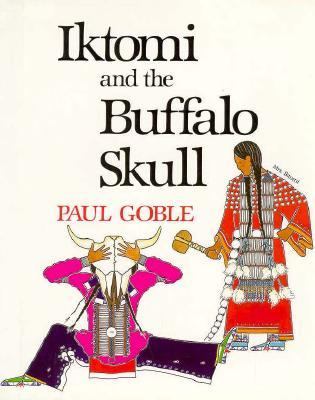
Iktomi and the Buffalo Skull follows a similar structure: an opening preface calling the story “white man’s lies,” then Iktomi walking proudly through the world. This time, he kicks his horse too hard and bucks him off. This leaves him disoriented: he can hear songs and dancing, but not see it. He eventually traces the sound to a buffalo skull on the ground, where mice are having a powwow. Iktomi asks to join, but the mice rightly say he’s too big. They do invite him to put his head in the skull, but warn him not to fall asleep.
What do foolish tricksters do…? When he wakes up, the buffalo skull is stuck, and Iktomi wanders blindly through the world until he bumps into a tree and falls in the river. Nearby ducks mock him, and the current carries him along until he nears people. He calls out for help, but some are scared, thinking it is a “buffalo ghost.” Eventually, some haul him out of the river, and then his wife frees him by smashing the skull with a stone hammer. And Iktomi walks on with a sore head.
These summaries aren’t really fair to the books’ design. Each is full of visual pleasure: we seen Iktomi from all angles, and at various sizes. At least once a book he tumbles upside down, as a trickster should. The colors are lovely, and the illustrations give kids a lot to spot. They are all also complex in various directions. Iktomi is always full of himself at the start of the book, but is always comparing himself: with others, with the well-known, with the past. In Goble’s versions of the stories (not traditional stories), he also judges himself as an Indian, such as for not speaking Lakota. There’s slapstick humor in each book, and actions that could be acted out well.