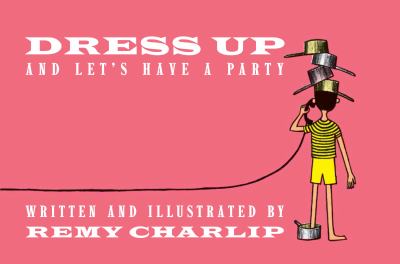
I recently read Fortunately by Remy Charlip. I enjoyed and appreciated it, and the experience set me looking for more Charlip. Hence, Dress Up and Let’s Have a Party, a 1956 picture book.
As I’ve mentioned in the past, my public library puts stickers on their picture books, as a kind of shorthand to help people know what they’re getting. Some categories are obvious, like “concepts.” Others are more intriguing. They labeled this one as “sparkly.”
Like Fortunately, Dress Up and Let’s Have a Party is a marvel of design. The title spells out the book’s premise quite directly, and Charlip puts it in motion right away. When his mother is baking a cake–at the far left side of the first page–John–at the first right side of the second page of the spread–dresses up in “pots and pans.” This gives him the idea to host a costume party, so he calls his friends and invites them.
And them come, one and two at a time. The book is laid out horizontally, so the pages are short and wide. Each two-page spread sets an action in motion at the far left, leaves considerable space, then presents a related action at the far right. Once the friends start arriving, they are often mentioned at the left, then move toward their costumed appearance on the right. Sometimes their presentation moves through three pages, and the action/space/action/turn/space creates some suspense and considerable sense of time passing.
Some of the costumes are pleasant, but predictable. Marianne, who likes wearing her mother’s clothes, shows up in those. Other costumes are new, but logical: Hans skipped the step of making a costume, but finds a cardboard box, and so comes as a package. Others are considerably more inventive, and are either fun in themselves (why did Vera come as spaghetti?) or revelatory (Sue and Viola in one skirt as a close friend). The sequence lets readers guess, anticipate, and enjoy within a well-designed frame.