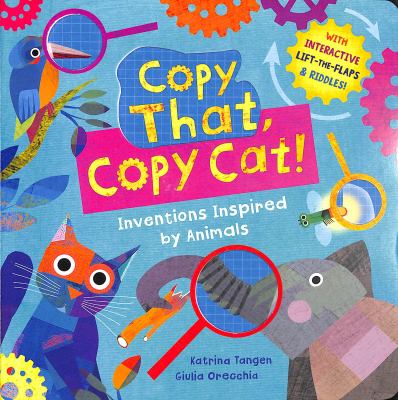
I love the idea, or rather, ideas behind Copy That, Copy Cat! Inventions Inspired by Animals. This 2023 book, written by Katrina Tangen and illustrated by Giulia Orecchia does multiple things at once.
First and primarily, it is a children’s book about biomimicry. It starts–just inside the front flap actually–by saying telling readers we don’t have to create everything from scratch. Instead, we can learn from nature, and, as the subtitle indicates, specifically from animals. The book walks readers through innovations drawn from birds, bears, and so on.
Second, it is a rhyming book. The left page of each four-page sequence presents a rhyming quatrain that is missing the last phrase to complete “Can’t you see that I’m…” The rhyme nudges readers to anticipate and fill in multiple patterns: what word fits both the content of the quatrain and the rhyme?
Third, it is a consciously constructed and interactive work. The right page of each four-page sequence has a full-page image with a hole in it. That hole shows a carefully formed and positioned image that could be interpreted in a couple of ways, ways that fit both the inspiring animal and the inspired innovation. For example, the first of these shows what looks to be a bird’s eye and beak, and then is later revealed to be the wing of a plane.
So, the images are created to both illustrate and suggest, positioned so they both look good on the page and fit with the spy holes, and so on. On the fourth page of the each four-page sequence readers first see the full image they glimpsed earlier, and then get a chance to lift a flap to learn more about the innovation and its relation to the source animal. So, the picture of the plane just says “a plane!” Lift the flap, and you get a brief statement of the relationship: “Plane wings are shaped like bird wings.” (Which is somewhat true, but somewhat…not.) The other has more diagrams and a bit fuller explanation. This gives parents and teachers options: you can show pictures and guess, you can reveal just the cover, you can read the single line, or you can read, show, and explain the more complex principles.
Fourth, the images are very bright and colorful, catching the eye.
Fifth, the back section has a page on the principle of biomimicry, more flaps to lift to learn about the animals on the cover and first page of the book, and two pages of “Lift-and-Learn” where readers can learn more about specific examples.
I love the overall goal here, and I’m impressed by the design. I have just two related concerns. One, the images are so bright and colorful I found them distracting. Two, the book is doing so much that it seems busy at times.
I like it, and suggest it, but I found myself blinking at times.