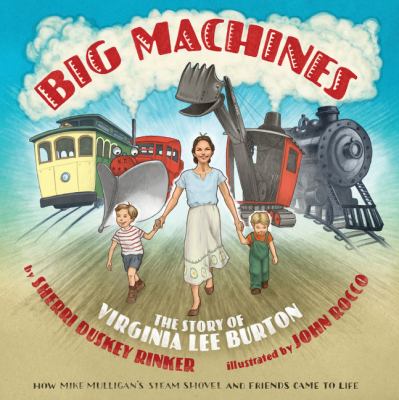
This is a well-made mediocre book.
That sounds harsh, but hear me out. The full title of Big Machines is Big Machines: The Story of Virginia Lee Burton. Burton created a number of wonderful and influential children’s book. The ones that stand out for me are Mike Mulligan and his Steam Shovel (1939) and The Little House (1942), which won the Caldecott. Burton very much deserves books written about her.
John Rocco’s illustrations for this book echo Burton’s. They share a style, and work well as an homage.
My quibble is with Sherry Duskey Rinker’s words and story. It launches directly into a discussion of what everyone in “seaside Folly Cove” knows about “Jinnee.” Readers get quite a list: she’s magical, grows things in an “enchanted garden,” talks to animals (and listens to them), and “can fly!” That’s all great, but we don’t get context. Is this describing a child? (She looks quite tall in the images.) A woman? Do the townsfolk think she literally does magic? I don’t know much about Burton’s background, and doubt a child would more, so…? For that matter, Folly Cove is a mysterious enough name for a fantasy story, and does not ground us.
Soon, we learn the two boys following her in the first pages are Michael and Aris, her sons, and the story becomes clearer: the “magic” she does is metaphorical, as she’s creating the wonderful things shown for her kids, sketching and telling steam shovels and trains and other big machines for them.
The end pages provide some pictures and a one-page biography that’s very useful, but also that introduces more questions. The first sentence says Jinnee “spent most of her childhood in California,” which left me wondering even more actively about what we see/are told. If Burton moved to Folly Cove as an adult, what were we shown in the first pages showing her listening to mice? What’s more, the biography mentions that she started the Folly Cove Designers, “which specialized in block printing.”
It does not say, though, that the group went on for decades, that it was almost all women, and that it developed quite sophisticated artistic practices. This collective organization is wildly interesting, and completely absent from the picture book itself.
Instead, we get a well-told but simplified and at times confusing myth about someone who was quite complex.