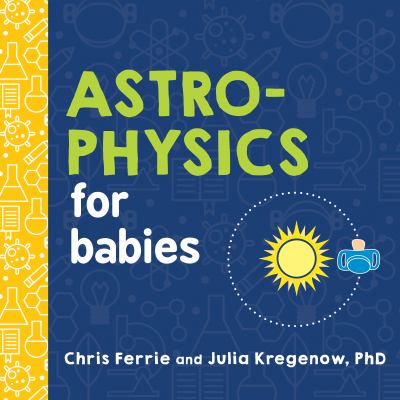
I recently read the 2018 board book Astrophysics for Babies by Chris Ferrie and Julia Kregenow. It is one of a number of books from Sourcebooks introducing complex topics to kids. These range from the advanced but general topic (like astrophysics or electromagnetism) to more specific topics. There is, for example, one introducing blockchain to babies, and another on neural networks. Ferrie wrote almost all of these books, either alone or with a co-writer. I intended to read more, but this is my first.
This book is good, but odd at times. Some aspects of it are standard to board books: the images are simple, the colors bright, and the text limited. (There are more words than many board books, but no more than two lines of text per page, and sometimes one.) The book opens and closes by drawing connections between common experience or the reader and the subject (as do some other pages). The first page, for example, reads, “This is a ball.” The second says that this is “the shape of planet Earth.” In between, some basic principles of astrophysics are introduced in a straightforward and helpful fashion.
The oddity I mentioned has two sources. First, much of the book is spent discussing the origins of elements. This is related and innately interesting, but it means we get astrophysics without discussing moons or other planets. Second, more of the language is metaphorical than I expected for a discussion of physics. For example, some pages talk about “stars that were living” and “stars that were dying.”
Those caveats aside, this is clear, interesting, and educational. Babies won’t care much about it, but inquisitive toddlers and preschoolers might.