Ah! A true joy.
And…how did I not read this earlier?
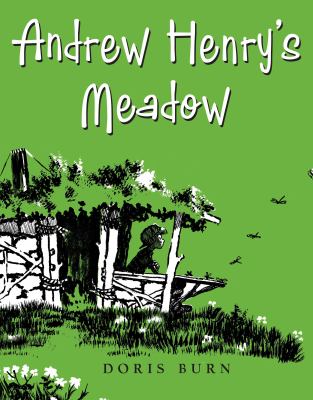
Let me start again. Andrew Henry’s Meadow is a picture book by Doris Burn, first published waaay back in 1965. I stumbled across it in a listicle on books that had been named on the New York Times/New York Public Library Best Illustrated Children’s Books Award list. Since this list names ten titles a year, and started back in 1952, that’s a lot of books. There were some I knew on the list, and many I didn’t. I started searching for them at my local public library, and voila! Andrew Henry’s Meadow.
It is easy to see why this book showed up on a list of best illustrated books. The illustrations are all black and white drawings, but they have the precision of a good wood block print. A quieter but no less impressive visual element is the design. Every page uses design exceptionally well. Some pages are all drawing. Some (okay, one or two) are all words. More often, though, the words and images work together in a skillful interplay, so the page about Andrew Henry building a helicopter has the helicopter in the upper section of the page, and the words below, while the next page had the words high and Andrew Henry’s mother standing below. Each image uses proportion and placement to focus attention. Images use lines to guide the eye, either within the image or between images. This is a master, and more impressive is the fact that this was her first published book.
The story is a pleasure too, though perhaps a little dated now. The Thatcher family has five kids, two older, two younger, and Andrew Henry in the middle. This isolates him somewhat, but what really sets him apart are two intertwined things: his ability to build and his independent spirit. He builds all kinds of things in the family home: the helicopter mentioned above, an eagle’s cage (!), a merry-go-round, and a complex pulley system. (He and Ada Twist are spiritual siblings.)
All of these impressive inventions get in the way, and his family complains, so Andrew Henry packs his tools and moves to a distant meadow, where he builds a house. (The family dog watches him go.) Once there he builds a house…and is joined by other kids. This twist genuinely surprised me. Each kid who joins him has their own passion that sets them apart from most people, and from their families. Alice loves birds, so Andrew Henry, even though he’s not much for birds, builds her a house, complete with birdhouses. George comes with his finishing things, and helps Andrew Henry build a bridge, then a house on the bridge, so he can fish.
Joe, Jane, Margot, and Sarah come along in time, each with their wonderful obsession, and Andrew Henry builds each of them a house, until there are nine.
Back home, their parents are going crazy with the kids being gone. They hunt for days, until the dog leads them to the village in the meadow, where there are many family reunions. And where the Thatcher family finds a place in their basement for Andrew Henry to build things.
The possibly dated elements of this are that all the kids and families are white, that there is so much untamed space, and that the kids are given such freedom.
But the wonders of this book are many and timeless. As I mentioned above, I was quite surprised by the kids who followed, and that Andrew Henry was so accepting and supportive–not just that he let them have their interests, but that he supported them even when he did not share them. That’s a truly great soul.
I will be seeking out everything by Doris Burn.