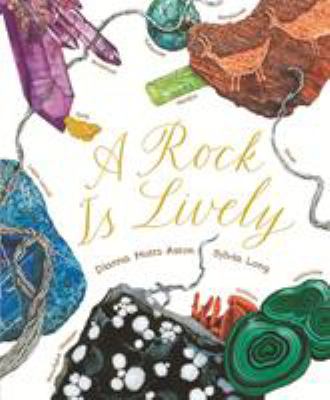
Last month I read Dianna Hutts Aston’s An Egg is Quiet. I enjoyed it, and have since learned that it is a series. There are several books with titles that start with “A/An Noun is…” and then close with a single descriptive adjective. In this case, it is rock and lively. The book on eggs had gone with an obvious connection: clearly, eggs are quiet. This one goes with an inverted or unexpected connection: how can rocks be lively? A Rock is Lively then answers that question.
Like the egg book, this one is illustrated by Sylvia Long, which means it is lovely. The colors are bright and rich; they made my fingers reach out to stroke some of the pages.
Like the earlier book, this one is built around a series of brief statements, which Aston then spells out and Long then illustrates. For example, one left page say s “A rock is galactic” at the top. The rest of that two-page spread then shows rocks in space, and explains meteoroids, comets, and asteroids. These sequences move throughout the world (and clearly space), and from the large (Mount Augustus) to the tiny (sand). By the end, we get statements that make a lively rock easier to accept and visualize.
The sequences here seem a bit more arbitrary than those in the egg book–for example, the claim that “A rock is creative” is illustrated with examples of people being creative with rocks–and, as I complained about before, the cursive script is so decorative at times that I can’t imagine kids (or some adults) reading it easily.
Those points aside, this 2012 picture book is lovely, and is a gentle way to sneak STEM into the reading rotation.