So I recently read and enjoyed I’m Trying to Love Farts by Bethany Barton. Since then, I’ve learned that Barton has actually written a number of books on similar topics and with similar topics. I hate to call it a series, because each book stands alone, and you can read them in any order, or just read, for example, the 2023 picture book I’m Trying to Love Germs. Or the 2015 picture book I’m Trying to Love Spiders. Or the 2019 picture book I’m Trying to Love Math. All of these-and there are more–are fun and educational. Each tackles a common topic that many people dislike (math) or fear (germs, spiders), or both. All of the books share a bold, bright, cartoonish style. Each debunks the fear, dislike, and /or ignorance around its topic, and each provides fun facts in a way that demystifies the topic.
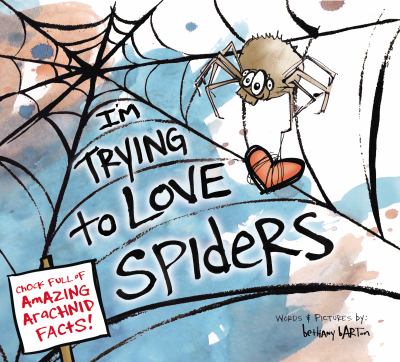
There are differences among the titles, though. I’m Trying to Love Spiders has lots of drama, as the unnamed narrator shares fears, interacts with spiders, and sketches in ideas and factoids about spiders. The voice is quite engaging–it’s a loud read, even if you are reading silently, if that makes sense–and carried me along easily. The examples of the many different types of spiders are quietly entertaining (there are side comments) and educational. What there isn’t, though, is a clear reason the narrator is sharing all of this, or a sense of context and identity.
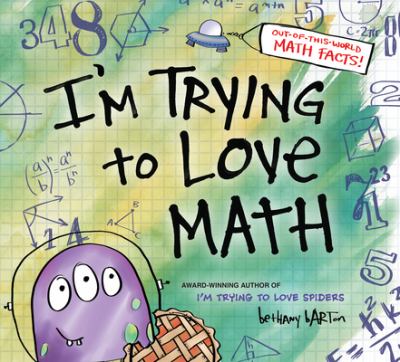
By contrast, I’m Trying to Love Math introduces a space alien second character early in the book, and that works well to drive the explanations. There’s a reason to talk math–space travel requires math–and more of a sense of the narrator as a person comes through. Where the discussion of spiders had been largely ahistorical and personal, this book brings in references to famous people (Einstein) and historical figures central to math (Pythagoras). Where the spider book had incorporated interactivity with lots of squished spiders, this one encourages readers to shake the book at one point, to get rid of the excessive numbers.
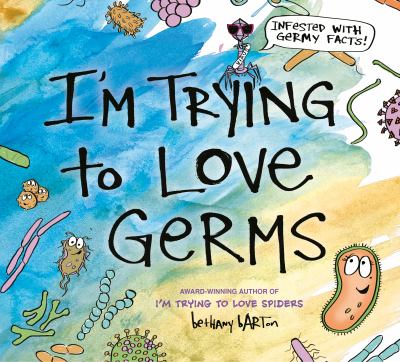
I’m Trying to Love Germs isn’t as engaging in the presentation of different germs as the spider book had been on spiders: it labels all of them just “germ” inside the front cover (though they are given individual names inside the back cover). It also has an odd back and forth on its pages over whether to call germs “germs” or microbes. (It is worth discussing, but the exchange doesn’t add much as far as either education or entertainment. In this one, the narrator discusses germs with a germ, and plays with making these microbes appear larger. Names of many common microbes are shared, and pronunciation guides are provided, but there are some gaps here. The two that stood out for me is asking if there is anything lovable about germs, and then not discussing the positive role in human health, and sketching out categories of microbes without really distinguishing among them. (What makes a fungus a fungus, for example?)
However, overall, this is a good and fun introduction to the topic, and I’ll be trying more of Barton’s books in the future.