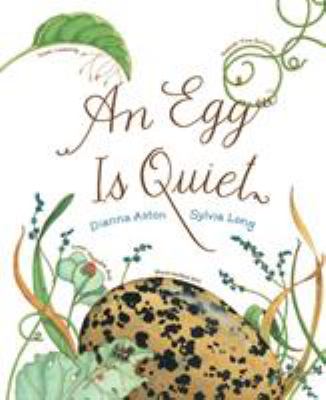
Dianna Ashton‘s 2006 picture book An Egg is Quiet is both lovely and informative.
This is a nonfiction picture book, so the information comes largely from Ashton. The loveliness comes largely from Sylvia Long‘s illustrations, which both accurately represent the various eggs featured here. However, in some cases, both qualities come from the interplay of word and image, and also design, as book uses repetition and progression well.
The book is pretty simple in its premises: lots of animals lay eggs. Those eggs share certain characteristics. The creatures growing in those eggs pass through similar stages of development…and the result is the wonder of new life.
What’s not as simple, and is quietly impressive, is the way the book guides readers and integrates so much in a small space. The book starts by using its title to point readers to a basic aspect of eggs: “An egg is quiet.” However, the book then repeats a similar phrase, changing only the final word, over and over: “An egg is–colorful, shapely,” and so on. This gives opportunities to focus, and to reveal variety within unity. For example, the page on shapely features (and explains) a round egg, an oval egg, a pointed egg, and a tubular egg. Each is shown, described, and contextualized, so readers can learn principles of biological adaptation. This continues until the eggs hatch and we learn “an egg is noisy!”
The book isn’t perfect–some of the text is presented like very fancy handwriting, making it hard to read–but it is good, valuable, and pleasing.