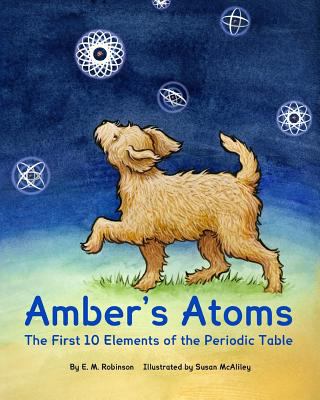
Amber’s Atoms: The First 10 Elements of the Periodic Table (2016) is an odd little picture book, but also a pleasant and useful one. As the subtitle indicates, this is a picture book about about the elements of the periodic table. Amber is a dog–a pleasant and friendly dog, judging by the illustrations. A smiling Amber opens the book in a folksy fashion, leaning on a literal white picket fence to introduce the game that runs through the book: guess the element.
The game is introduced in a rhyming quatrain with an ABCB structure: the second and forth lines rhyme, but not the first and third. These first pages also set up a structure: quatrain on one page (followed by “What is it?”), image featuring Amber on the other side. These illustrations by Susan McAliley are sometimes self-contained, but sometimes sprawl onto the poetry page. The illustrations are pleasant, but vary in how directly they are tied to the specific element and how much of a clue they give readers. For example, for hydrogen, the image is Amber leaning on and looking at a globe…which isn’t that close a tie. By contrast, for element 2, helium, Amber is prancing through the back yard, playing with a helium-filled balloon on a string.
After these pages, there’s a page with formal representations from the period table on one page, and a stylized diagram of the element’s atom on the next. (For example, the nucleus of hydrogen, a single proton, is a red ball, with a single electron in blue moving through a white orbit around it. The heavier atoms add neutrons in gray.)
Taken together, these elements give the book a great structure: it is easy to follow this, and to anticipate it. Add Amber’s clear friendliness, and this is a painless, even enjoyable, introduction to aspects of the period table. (Side note: apparently Amber’s based on author E. M. Robinson’s actual dog.)
There are some elements (ha!) of the book that aren’t as strong. For example, I understand putting the glossary at the end, but it means kids will encounter the atom diagrams without knowing what the different components are. A larger challenge is that the periodic table isn’t really defined, or and there’s no real explanation as to why specific elements are placed where they are. A different challenge is that while the tone is gentle, some vocabulary will be advanced.for picture book readers (and are not defined to help homeschooling parents). For example, do kids know “oxidizes”? And does the average adult know what a “noble gas” is?
But I enjoyed it, and applaud the effort.