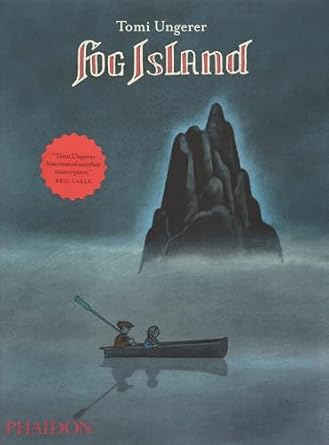
As I may have mentioned, my local library has a free book area down in the basement. This produces some fantastic finds, and, necessarily, a fair degree of randomness.
That’s my lead in to saying I found Tomi Ungerer’s Fog Island in the basement, between a cookbook and a book of middle school math problems. I embarrassed to say I had not heard of Ungerer before this, and was stunned to see an endorsement from Eric Carle on the front. So, Fog Island.
I’ve since looked up Ungerer, and learned he was a writer and artists with over 100 books to his credit! I’ll be exploring him further in the future.
For now, in practice, it means I approached this book with no expectations. It is oversized, with numerous full-page illustrations, and, on the text-only pages, lots of white space. It is easy to see the artist’s eye here. However, when the first page introduced “Finn and Cara” and said these siblings “lived by the sea in the back of beyond,” I didn’t know where we were headed: realistic setting, historical, imagined, etc. The images suggested some time in the past, what with the mother churning butter, but the picture of a woman bottle feeding a sheep looks more modern. Given the writing with a fountain pen, I concluded generic past, rather than, say, eco-friendly modern.
The story moves at a deliberate pace, sketching in the family’s daily lives, showing what they did, and giving glimpses of the landscape…which leads easily to the father warning the kids to “stay clear of Fog Island!”
However, one day, when the kids were exploring in a curragh (a small reed boat, tarred to make it watertight), the tide takes them. The illustrations of fog, and of the open sea, are striking. They find their way to an island, which is of course Fog Island, and meet the Fog Man who lives there. He makes the fog using a boiler that reaches deep into the earth–another great, almost surreal image.
Since no one visits the Fog Man, he is lonely, and he makes the kids at home with food and stories. They spend the night, and wake up “in the midst of ruins.” Finn and Cara head for home, but get taken by a storm, and the village fishermen have to row out in slightly bigger boats to rescue them. There’s a celebration that they make it back alive –but no one believes their story. The siblings say they can prove their story…but no one is willing to go back to the island to check.
This at once someone isolates the kids, but also gives them a shared private experience they refer to and joke about.
This book gives a great sense of the otherworldly feel that the sea and storms can carry, and evokes the alien nature of other times. And it’s got great illustrations.
(This book is dated 2013, but feels much older.)