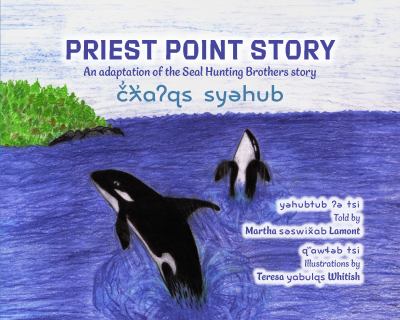
Priest Point Story: An adaptation of the Seal Hunting Brothers story is an interesting little book.
It’s interesting in several ways, one of which makes it hard for me to write about it accurately. I stumbled across it when looking for picture books from my area: Washington state (maybe even Bellingham specifically), and the Pacific Northwest. This showed up in a library search, so I picked it knowing nothing about it except that it relates to my region.
The Tulalip Lushootseed Department published this book. This organization’s mission is to preserve the traditional teachings of the Tulalip people. These Native American tribes live in my area, with Lushootseed speakers found from Olympia in the south to Skagit County in the north, and from Hood Canal in the west to the Cascades in the north.
Priest Point is in that region (Olympia area, south of Seattle), and, as the book informs us, the Snohomish people lived there. They lived happily and ate well, at least until two seals arrived. They were voracious, and ate everything, so much that the Snohomish were starving. Then, a woman from that community called out to the killer whales, with whom she shared ancestors, and asked for help.
The whales heard.
The whales came.
The whales ate the seals’ heads.
After that, all the food came back, and that’s why a killer while is on the crest of the Tulalip tribes (as shown on the website for the tribal court).
The story is simple, but focused and graceful: it has the feel of a story polished through oral storytelling. (In fact you can hear the story of Priest Point–the traditional one, not this book’s version, on YouTube..)
In addition to the English version I read, each page of text features the story in Lushootseed, which includes marks I’m not sure how to get my computer to make. The book bridges past and present to future by including a QR code at the front and inviting readers to scan it and read along. All of these details, along with the biographies of writer Martha Lamont and illustrator Teresa Whitish, position this well as a work of cultural heritage.
One element of the work is confusing, and, to be honest, does not work as well. The Tulalip people have a long and rich tradition in the visual arts…and the images here don’t seem part of that tradition, or, again, being honest, to be as vivid as the story.