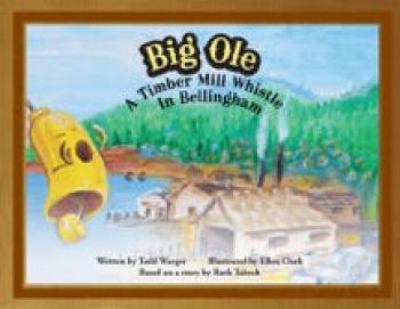
I live in Bellingham, Washington. It’s a good-sized town about 85 miles north of Seattle. It’s fairly artistic and literate, and I got curious if there were picture books about it. There are, and Big Ole: A Timber Mill Whistle in Bellingham (2017) is one of them. It is written by Todd Wagner (historian here in the Pacific Northwest), but based an unfinished story by Ruth Tabrah, a children’s book author who lived in Bellingham (and then Hawaii). Ellen Clark, a Bellingham artist, did the illustrations.
And I hate to say this, because I meet the creators walking down the street, but Big Ole is not good. It isn’t terrible, but it isn’t good. Some of this may from a muddled vision (too many creators) but some comes from an odd tension between what’s explained and what isn’t. And some of it is writing that could be clearer. We start with “One day, a steam whistle awoke from a foundry.” From a foundry? Not in one? Meaning, does this mean “One day, a steam whistle awoke in a foundry”? Or “One day, a steam whistle from a foundry awoke…” somewhere else? On that same (wordy) first page, the factoid of Bellingham Bay, the body of water Bellingham is on, is mentioned, but not what state or country Bellingham is in. This sort of “did we need to know that/we needed to know more over here” continues throughout the book.
As local history, the book is interesting: following the steam whistle through its life/career becomes a way to tell the story of Bellingham’s development. That’s useful, and the images of the changing landscape may well draw young readers. Likewise, the ten pages of actual photos of the whistle and the town provided at the end of the book let kids see what the town actually looked like, and may draw them to history.
However, the core story seems torn between telling what happens and giving Big Ole a character and meaning of his own, and so the book itself is on the flat side.