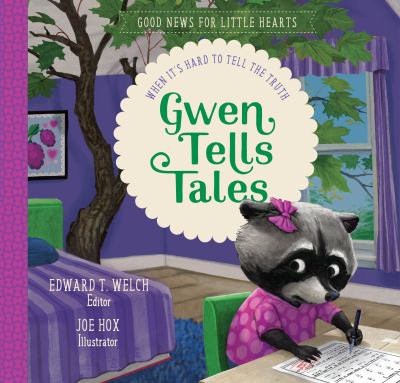
Gwen Tells Tales (2021) is an odd and uneven book. The subtitle is “When It’s Hard to Tell the Truth,” and it is part of a larger series of children’s books titled “Good News for Little Hearts” from New Growth Press, a Christian press based in North Carolina.
Some of the oddity is the presentation. The cover lists an editor (Edward T. Welch), but no author. (An interior page lists Jocelyn Flanders as responsible for “story creation,” but is this just the idea? The writing?)
More of the oddity is the placement of Christianity in the book. It opens with a Bible verse, and ends with verses being distributed to the entire family, but there’s no faith, church, or Bible throughout the story itself. In fact, the family seems entire secular, and the parents leave their kids at home without adult supervision so they can go play a game with friends. In other words, they seem like fairly poor models for their kids (and for readers) if the goal is to teach a family-centered and biblical worldview. It is also interesting to consider who Christ would be in a world inhabited by different sentient animals. Was Jesus a hedgehog? A turtle? A human who sacrifices himself for animals?
The story itself is preachy, which is clearly intentional, but also a bit wordy, which I assume isn’t. The story is simple: the parents leave the kids home on a school night, specifically one when Gwen (a raccoon) has a math test the next day. The parents make the kids promise not “no screen time” before they leave to play cornhole. Gwen agrees, but she’s lying. She knows she plans to play games online with friends.
She fails her test, and then signs her mom’s signature on the test, indicating the mother’s seen the failing grade. This works for a while, but Gwen’s exposed when she and her mother run into Gwen’s teacher. Then, the only interesting thing in the book happens. After they’ve seen the teacher and Gwen knows she’s busted, she sees her mother lie to a friend about how much she practices cornhole. Gwen asks about this lie, and this leads to a fairly natural discussion of Gwen’s lies, and into the lesson about not lying and the ending Bible verses.
The mother’s lie is interesting because she seems to lie easily, almost instinctively: she has less excuse for her lie than Gwen does. While the mother admits her lie, she does so without any religious reflection at first. In other words, she’s modeling lying and depending on herself, not faith, for her daughter.
Joe Hox’s art is nicely colorful, and while it is not especially memorable, it does a good job of illustrating what’s going on and what Gwen is feeling.
But the story and the preaching are a tangle.