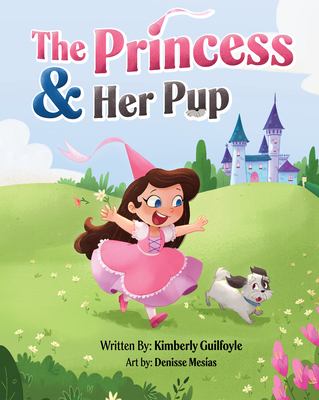
Reading this book was a strange experience, but let me start by being honest: it was not as bad as I expected.
Let me start again. The Princess & Her Pup is a 2024 picture book. The cover says it was written by Kimberly Guilfoyle, but BRAVE Books, the publisher, says “Kimberly Guilfoyle and BRAVE Books partnered to write The Princess and Her Pup,” which suggests there was likely a ghostwriter (or active editor) involved. Guilfoyle is a political figure–advisor to President Trump’s campaign, former fiancee to Donald Trump, Jr., and pundit/speaker in conservative circles. There are news stories about her being involved in sexual harassment (as the aggressor), and multiple stories about her being openly sexual in surprising contexts, such as reports that she offered a lap dance to Trump donors.
She is, in short, not someone I would expect to write children’s books, and I was curious, even skeptical, so let me repeat: this was not as bad as I expected.
It was not, however, good. As the title suggests, this book is about a princess (named Kimberly). She was, we’re told “the sweetest princess of all,” which sounds egotistical. She had, however, fears: bugs, crowds, and a creek. Her parents try to help with her fears, but can’t.
Somewhere else in the kingdom, there’s a puppy who is also scared of things: the sound of the wind, rocks, and “giants” (humans). Somehow the pup ends up in the middle of a human crowd, and Princess Kimberly is spontaneously moved to make sure he’s safe. She picks him up, reassures him, and keeps him. He becomes part of their family, and they reassure each other.
This isn’t a good book: nobody’s fears are connected to each other or anything else, and, while we’re told Kimberly is “gentle and loving,” we don’t see her being nice until she sees the pup that needs rescuing. Everything is arbitrary, in other words, and feels forced. BRAVE Books makes a point of publishing books that teach a “biblical, wholesome message,” but there’s no religion, faith, or church in the story itself, just an afterword that talks about God and offers a Bible verse. Again, arbitrary: you could add this sort of message to any story, since it is unrelated to the characters or story.
The art by Denisse Mesias appears computer generated and generic: no one will remember these images in particular. But they do work to illustrate the story, and the story does move through a recognizable arc.
I can imagine kids sitting still for this once, but not twice. I assume this was published because Guilfoyle has a conservative following.