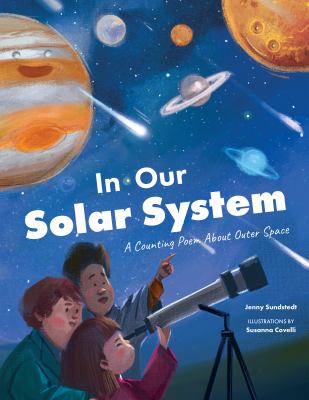
In Our Solar System: A Counting Poem About Outer Space, a 2025 picture book by Jenny Sundstedt, is markedly uneven.
I applaud all the (very different) goals for the book. This book rhymes, it features numbers, and it provides useful information about various components of our solar system. I’m all for science and space education, so, good goals.
But…the different parts don’t really fit together. To start, this isn’t really a counting book, despite what the subtitle says. The pages are arranged from the sun outward, and that makes sense…but. But the pages on the sun is dedicated to the number one–but the rhyming verse features two solar flares, the mother flare and her “little flare, one.” Okay, but the illustration by Susanna Covelli shows more than one solar flare (or at least, bright blotches that are close enough to flares that I wasn’t sure how many flares are present).
The pages are arranged with the rhyming verse in larger font and the strictly scientific information below in a smaller font. The verse on the pages following the sun describes “a planet speeding through” the solar system, but strictly speaking, a planet passing through a solar system is a rogue planet. The verse also doesn’t name the planet, adding ambiguity, but it does mention a “father crater” and his “little craters, two.” Fine, humanizing celestial objects to connect with them is an ancient practice…but the illustration shows more than the three craters mentioned. Are the other (more than a dozen) craters…pets? Cousins? The smaller text discusses Mercury, which adds more confusion, since NASA photos dating back to 1974 show Mercury pockmarked with craters (see image below). So, is this Mercury? If it is Mercury, the first planet from the sun, giving it number two could confuse young readers. Is this some rogue plant passing through?

Mercury (Photo credit: NASA/JPL/USGS, 1974)
This same unevenness occurs throughout the book. The verse might engage, but it doesn’t always line up with the images. The numbers sometimes align with the images (for Venus we count volcanoes, and the image does show three volcanoes, the number mentioned in the verse), but sometimes do not. Jupiter, the fifth planet, gets the number six, for a mother storm and six “little storms,” but the image shows more than six–though only six are given faces. Saturn, the sixth planet, is shown with a “father ring” and “his little rings, seven.” That means the image shows eight rings. This both thwarts simple counting, and departs from the facts–NASA indicates Saturn has seven main rings, not eight–without mentioning the actual number in the informational section.
I’ll pause here, and just say that the images are pleasant and colorful, but this book’s concepts and design need review.