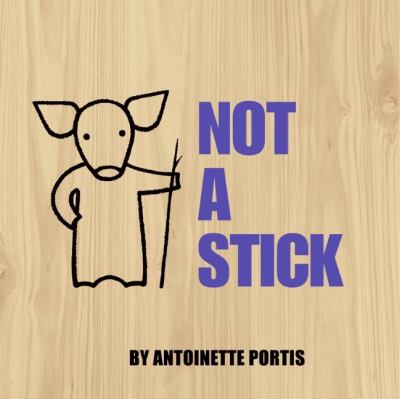
Almost all of the reviews to date have been of new works, that is, works or adaptations that were new to me.
Today I’m trying something different. I’m revisiting a book that has been one of my favorites ever since I first read it, the 2008 picture book Not a Stick by Antoinette Portis. My main goal is to reflect a bit on what makes it so appealing (and to share this great book with you).
So. What makes Not a Stick so wonderful?
I would have to say the purity and the joy.
By purity I do not mean something ethical, though this book is perfectly clean in that regard, with no foul language or adult topics. No, by purity I mean the creator’s vision for her work is exceptionally pure: it is clear and unified, in both idea and execution. This is a book about the wonder of imagination, specifically the child’s imagination–and it is executed with extremely simple writing and drawings, through exceptional design.
The book opens with a single line of text on the (brown) left page: “Hey, be careful with that stick.” On the (white) facing page, there’s a piglet holding a stick.
Except, as the third (blue) page tells us, “It’s not a stick.” Page 4 (black, white, and yellow) shows the piglet from page 2, in almost the same posture, except that the stick is now a fishing pole, and it is fishing for, and about to catch, a shark.
And thus a pattern is established: a warning or command is given on a (brown/dull) left page, facing a simple image of a piglet with a stick. Then next (blue/brighter) page counters the words, and the fourth page shows a much more complex image of the piglet–of what the stick is for them, right now.
Those images become more complex later in the book, and there are a couple of two-page spreads with larger, richer images, but the same general pattern holds. And it is a pattern that’s easy to recognize, both from the adult perspective and from the kid perspective. Kids will enjoy seeing all that a stick can be and do, and will likely imitate the images and do their own improvisation.
This book could also be used as a primer on how important design is.
Love it.