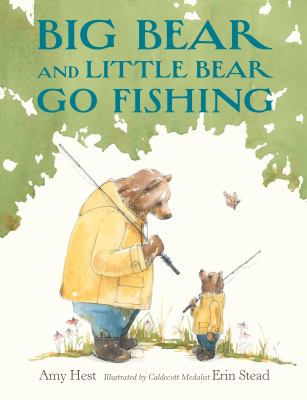
Amy Hest’s 2024 picture book Big Bear and Little Bear Go Fishing posed a small question for me: why does this book seem timeless, but also new?
Some of this may be Erin Stead’s illustrations. I’d seen her Caldecott-winning style in past works, and that may be what makes them seem familiar. I think more of it, though, is how both the situations and the images echo longstanding tropes but take them in new ways.
The opening pages, for example, present a nicely focused exchange that could have appeared in picture books 50 years ago. Big Bear says to Little Bear, “I’m just in the mood for fishing.” And Little Bear answers “Me too” and “Just in the mood.” But the image on the opposite page shows a bear small enough to not really know what fishing is, and who is agreeing to spend time with a parent.
Big Bear’s pajamas, stance, and cup of coffee (paired with the offer of fishing, which is more often associated with guys) made me think this was a father bear. And the preparations for fishing are standard enough that Big Bear could be the dad…until, after pants and boots and coats and poles, Big Bear mentions they “need nice, warm blueberry scones.” To which Little Bear answers “Oh yes.” And they stop to gather berries, and to bake, before they go.
This shift the book away from traditional gender roles, and slowing down to gather and bake pushes the narrative away from the apparent task of fishing and into something much more special: drifting, unbound time shared by adult and child, a time when everything is shared and everything is okay, And the later pause to add a book full of stories underscores that.
The pair eventually go fishing, but when no fish show up, they wait. And eat the scones. And wait. And read all the stories. And eventually see a fish. Who gets away. And they go home and nap in the hammock, poor in fish, but rich in love and memories.