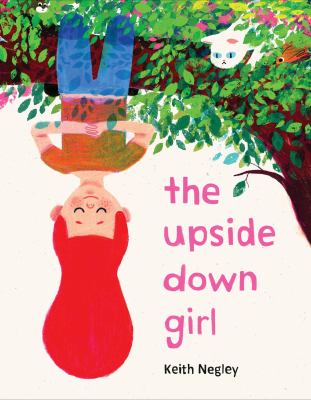
I love the focus and premise of Keith Negley’s 2026 picture book the upside down girl. There’s a girl hanging upside down from a tree. She catches the eye of everyone who walks by–a kid, a businessman, an old woman, a postal carrier–and each engages with her. They all see her through their own lenses (as when the businessman points out this is “no way to make a profit”) and engage with her briefly.
Each person speaks for her to the next. The sheriff arrives, then a crowd, then the fire marshal. They all chime in, denouncing her choice to hang upside down. She ignores them. Finally, the major asks why she hangs upside down. She’s willing to tell, but warns them it will change everything, and asks if they still want to know. They say they do.
She tells them–but not the reader–and they are shocked. And then they are upside down in the tree with her.
That summary really doesn’t do this justice. This book is purely kid-like: sometimes kids do things that baffle others, for their own reasons (and are more likely to hang from trees than adults). But it is also deeply meaningful, even philosophical. It shows how upset people get when people don’t act like they do, even when they are not bothering people. It also, in a move reminiscent of Plato’s cave, shows that once one person has seen the world a different way, everyone and everything may change: the Upside Down Girl as philosopher/prophet.
And the summary also doesn’t communicate the joy the images create, The Upside Down Girl has red hair, hair that dangles in a bright, bulbous shape throughout the book. It provides a focal point for individual images and continuity throughout. Her red hair is the symbolic and literal pivot point for the two-page spreads showing community response to her hang. The illustrations are simple (I’d say intentionally so), but communicate emotions clearly.
A good book, one that can be enjoyed but also used to teach.