Recently the AOI (Association of Illustrators) announced their selections for this year’s World Illustration Awards. One category is for children’s publishing, and if you ever want a pleasant rabbit hole to fall into, this is one. Those honored are varied and vivid, and give a real sense of what’s possible.
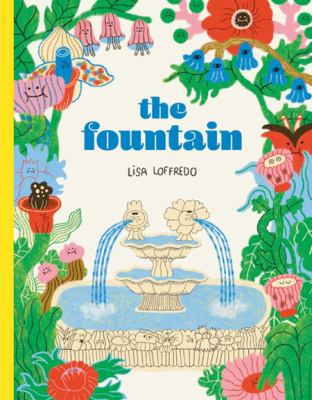
That’s where I learned about Lisa Loffredo. Born in Italy, currently living in Amsterdam, Loffredo is an illustrator and a picture book creator, producing works such as the fountain.
In structure, the fountain is similar to Extra Yarn. In both cases, an unexplained magical item appears in a community. It’s a box of yarn in Extra Yarn, and in this case, an existing but previously mundane fountain turns magical, suddenly spouting not just water but a hat, a drum, and then a series of other items.
In both books, the magic is defined by its abundance and its wonder: it just keeps coming. In both cases, it unifies and transforms a community. In Extra Yarn, these are directly linked: now everyone in a community has a newly knit sweater (or hat). In the fountain, it is a bit more complicated. The town is united first by “buzzing” with talk about the fountain, then by everyone (or at least everyone shown) getting something from the fountain, then coming together to deal with the creations–and then to theorize why the fountain was doing what it was doing.
In both books, the local wonder brings outside attention: an unscrupulous noble in Extra Yarn, outside experts here, who come to try to explain the fountain (and aliens who come to wonder at it). Finally, in both books there’s a disruption in the gifts. In Extra Yarn, it happens when the the cursed archduke steals the yarn (for a while), but resumes. In the fountain, the disruption is the town’s own fault: the people become obsessed with the fountain and it eventually disappears, reappearing to spill water–and gifts–in another, less crowded location. After it is gone, the town is shaped by its absence, quite an adult and somewhat melancholy note.
Both books demonstrate the danger of greed, and teach moral/emotional lessons in the process.
One joy of the fountain is the illustrations that won Loffredo her awards (and brought her to my attention in the first place). They are a pleasure. The people in the book are mostly human (at least at the start of the book)…but some have antennae and wings. Later, they have later range. (Is the blue being with the balloons a walking cloud?) There’s a similar blurring in other areas: the flowers circling the fountain’s base have very expressive faces, and are clearly all up in each other’s business.
Loffredo uses color to link pages: the hat that is the fountain’s first gift is the same yellow as the drum that is its second gift, and the rocking horse that is its third. So are the fountain’s other gifts throughout the book. Beyond the simple unity, this gives kids something to spot, drawing their attention the shoes on one page, the bananas on a later. (Does this also suggest they are made of gold?)
Design, scale, and perspective shift around to underscore major moments in the book, and produce some of the pages most likely to make kids smile, like the two-page spread of fountain gifts–all yellow–that range from “things with stripes” to “yummy things” and on to “things they didn’t know what to make of” and “things that wouldn’t fit on this page.”
Good stuff. The images will make it appeal even to non-readers.