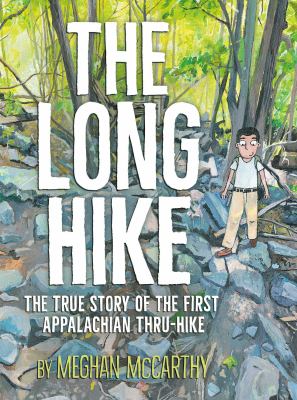
I can sum up my response to Meghan McCarthy’s new (2026) picture book The Long Hike: The True Story of the First Appalachian Thru-Hike easily: a great idea about an essential topic, but it needed an editor.
Let me expand a bit. The book opens with facts that are also a great hook: every year more than 300 people try a “thru-hike” of the Appalachian Trail, walking from Georgia to Maine in one season. Only 1 in 4 make it. I’m in! I want to learn more.
The book then steps back to give the history of the thru-hike, which McCarthy traces to World War II serviceman Earl Shaffer. He dreamt of home while fighting the war, and came back depressed, and with the idea to walk the pain away on the trail.
The book follows Earl on his hike, sharing and showing what he carried and what he walked through, and sketching in bits of background and context.
McCarthy quotes Earl’s journal, letting his experiences lead readers through the book, through the months, and along the trail. Some external facts get introduced that drive home the difficulty of this hike, like the fact that Earl climbed Mount Washington, a New Hampshire peaks with extreme weather (like a 2023 low of -46.9/windchill of -108.4!).
After following Earl to his successful conclusion of the trail, the book skips forward to different points in time, like his final trek on the trail at “nearly eighty.” He was the first thru-hiker on the trail, and this trek made him the oldest recorded.
After concluding Earl Shaffer’s story, the book gives an extended author’s note, a section titled “The Trail Today,” a glossary of “Trail Lingo,” and suggestions for further reading.
The book does a fine job of evoking how solitude and nature healed Earl’s soul.
So why do I say the book needed an editor? Because of the wording and what’s missing. The opening pages mention the trail goes from Georgia to Maine, but doesn’t give the mileage or mention it goes through the mountains (and new/child readers won’t know this). When Earl is introduced, readers are told he was “a soldier during World War II,” but not his nationality. That comes later. When explaining the motive for the walk, the phrase “calming and restorative embrace of nature” is used. That seems very advanced for picture books. When the book shows what Earl carried and wore, it doesn’t explain everything. Will kids know what “Bird shooter boots”? (Will they assume he’s hunting his way along?) The term doesn’t appear in the Trail Lingo section, so…? Since I’m asking, why not alphabetize the Trail Lingo?
I am glad this book got written, and I applaud its mission, but it could be smoother and more useful with an edit.