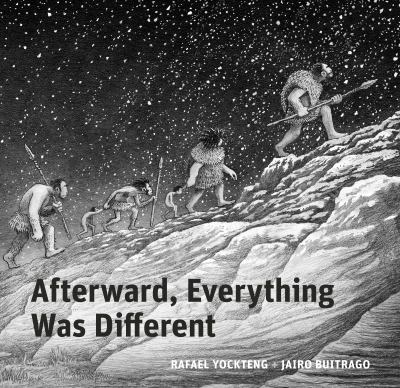
This 2023 picture book is ambitious and intriguing, but not fully successful.
The ambition comes from two sources. First, author Jairo Buitrago and illustrator Rafael Yockteng try to tell the story of major advances in human development from long, long ago. There’s a page at the end of the book that says this era (the Pleistocene) stretched from 2.5 million years ago to 10,000 years ago. Second, they do so without words in the book itself.
Instead, open the book and you see vivid and engaging black and white illustrations, all of which spill across two-page spreads. These are full of action: we get a stampede, a volcano erupting, a pack of humans hunting much larger animals, and the animals counterattacking (several pages of this). That all happens before the title page, which is the first place we get the subtitle: “A Tale From the Pleistocene.”
Then we get more scenes of these rough humans (almost cliches of cavemen) in motion, hunting, or facing extreme weather.
Late in the book, there’s a breakthrough: one of the younger humans starts drawing on cave walls, capturing images from their hunt (apparently in charcoal from their fire). This young artist is then shown rising a torch to show the rest of the pack, and a parental figure hugging her.
Then and only then do we get a page of explanation celebrating the artist and the importance of painting cave walls in this way. Finally, we get the page mentioned above giving the larger historical frame.
The art is great: vivid representations of massive creatures long vanished from the world. The art is unified: all black and white, all sprawling. However, the art is also a bit confusing. The page celebrating the young artist mentions pigment, and the cave paintings still extant are often quite colorful. This book, though, shows only black and white illustrations…without saying why. I fully expected the images to change to color, or to start including splashes of color, at the end. I was wrong.
The choice of a wordless book draws focus to the images, but it also leaves any parents and teachers who read this with a lot of research to do if they want to explain this. Keeping the book wordless when humans started using language during the Pleistocene, but not explaining why was mildly confusing.
So, I enjoyed this book. I salute this book. But some choices confused me, and won’t well for all readers.